
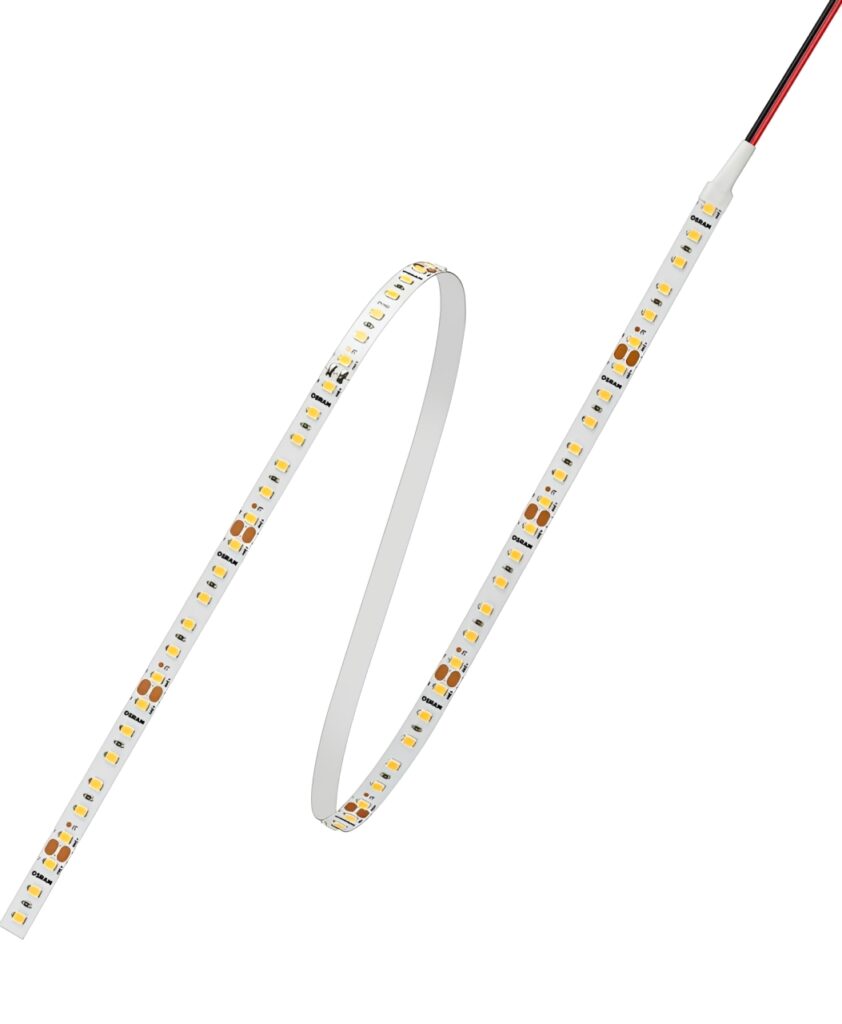
A successful retail display does not always need brighter lighting. Instead, it needs light in the right place, with enough consistency to reveal products without creating glare. An Osram LED Strip Light can help designers achieve that balance by providing a slim source of illumination that follows shelves, counters and display recesses.
For a project requiring warm-white illumination, the Osram LED Strip Light, model BF1500S-G3-830-05, offers a practical starting point. This BASIC FLEX G3 Shortpitch strip measures 5 m long and 8 mm wide, runs on 24 V DC and produces 3000 K light. It contains 120 LEDs per metre, with a published luminous output of 1,510 lumens per metre under specified test conditions.
Why Should Lighting Follow the Customer’s View?
A display looks different when viewed standing, seated or walking past. Light placed too close to the front edge of a shelf may shine directly into customers’ eyes. Position it too far back, and product labels can remain shadowed.
Therefore, start by marking typical viewing positions before selecting mounting locations. Test whether packaging, glass surfaces and polished finishes reflect noticeable points of light. A simple temporary lighting arrangement can reveal problems that drawings do not show.
How Does Warm White Affect a Product Display?
At 3000 K, the strip gives off warm-white light that often complements timber, neutral interiors and hospitality displays. Its colour rendering index of 80 is suitable for many general applications, but demanding colour-critical merchandising may need a different specification.
The aim is visual clarity, not simply atmosphere. If customers struggle to distinguish labels or details, change the position, surrounding materials or lighting specification rather than increasing brightness automatically.
What Should You Measure Before Cutting a Strip?
Measure every shelf, recess and cable route separately. A 5 m reel may serve several shorter sections, but the total illuminated length is only one part of the plan. Connection points, corner transitions and access for future maintenance also take up space.
The manufacturer’s documented smallest unit is 50 mm. Cut only at the marked positions and use compatible connection methods. The strip’s minimum bending radius is specified as 20 mm, so sharp folds and forced corners should be avoided.
How Can You Keep Brightness Consistent?
Plan the supply arrangement before fixing the strip permanently. The complete reel has a rated power of 62 W, and the LEDs require a regulated 24 V DC supply. Suitable LED Drivers must meet the electrical load and system requirements.
For extended runs, consider cable length, voltage drop and the recommended power-feed arrangement. Carefully selected LED Cables and sound connections help avoid uneven illumination, particularly when lighting several separate display sections.
Why Does Mounting Quality Change the Result?
A bright strip installed unevenly can produce an untidy line of light. Crooked mounting, exposed wiring and poorly aligned profiles can distract from the products you intended to highlight. Installation quality therefore deserves the same attention as light output.
Appropriate LED Mounting Hardware helps secure lighting components and keep their position consistent. For strip-specific installations, confirm that the chosen channel or profile suits the strip’s 8 mm width, adhesive surface and heat-management guidance.
Should You Hide the LEDs Behind a Diffuser?
A compatible diffusing cover can soften visible LED points and make a display look more continuous. However, every cover changes the light leaving the assembly, and some reduce usable output significantly.
Build a short sample before specifying profiles across an entire shop. Compare the appearance with products in position, including reflective packaging and dark shelving. The best finish is the one that presents merchandise clearly without drawing attention to the fittings.
How Can You Avoid Problems With Moisture and Heat?
The BF1500S-G3-830-05 is an IP00 product, so it does not offer ingress protection. Keep it in a suitably protected indoor installation and do not assume that an open display cabinet shields it from spills or condensation.
Temperature also affects LED performance. Follow the manufacturer’s mounting and thermal guidance, avoid insulating the strip unnecessarily and provide ventilation where required. LED Driver Accessories may help organise associated equipment, but their suitability must be checked individually.
Can Lighting Scenes Change Throughout the Day?
A shop may need stronger illumination during deliveries and restocking, followed by softer display lighting when customers arrive. In hospitality, a breakfast counter and an evening service area can benefit from different brightness settings.
Compatible LED Lighting Controllers can provide scheduled or manual adjustments when paired with the correct dimming equipment. The strip supports dimming through a suitable system, but the controller and power supply must use compatible methods.
What Should You Check During Commissioning?
Before handing over an installation, test it in the conditions in which people will actually use it:
- Confirm correct supply voltage, polarity and secure connections.
- Look for dark patches, excessive glare or visible colour differences.
- Check the strip and power equipment for abnormal heating.
- Verify dimming response without unexpected flicker.
- Ensure cable routes are protected and accessible for servicing.
Record the equipment used and provide clear maintenance instructions. A small amount of documentation can prevent incorrect replacements when store layouts change.
What Makes an LED Display Installation Last?
Long-term success depends on more than choosing a bright strip. Good viewing angles, appropriate thermal conditions, secure fittings and compatible control equipment all help preserve the original design intent.
For smaller trial projects, LED Kits may offer a convenient way to test a lighting arrangement before committing to bespoke wiring. For a fully planned display, compare suitable LED Strip Lights by light output, colour quality, dimensions and protection rating. The result should be a display that is clear to customers, straightforward to maintain and comfortable to experience.