
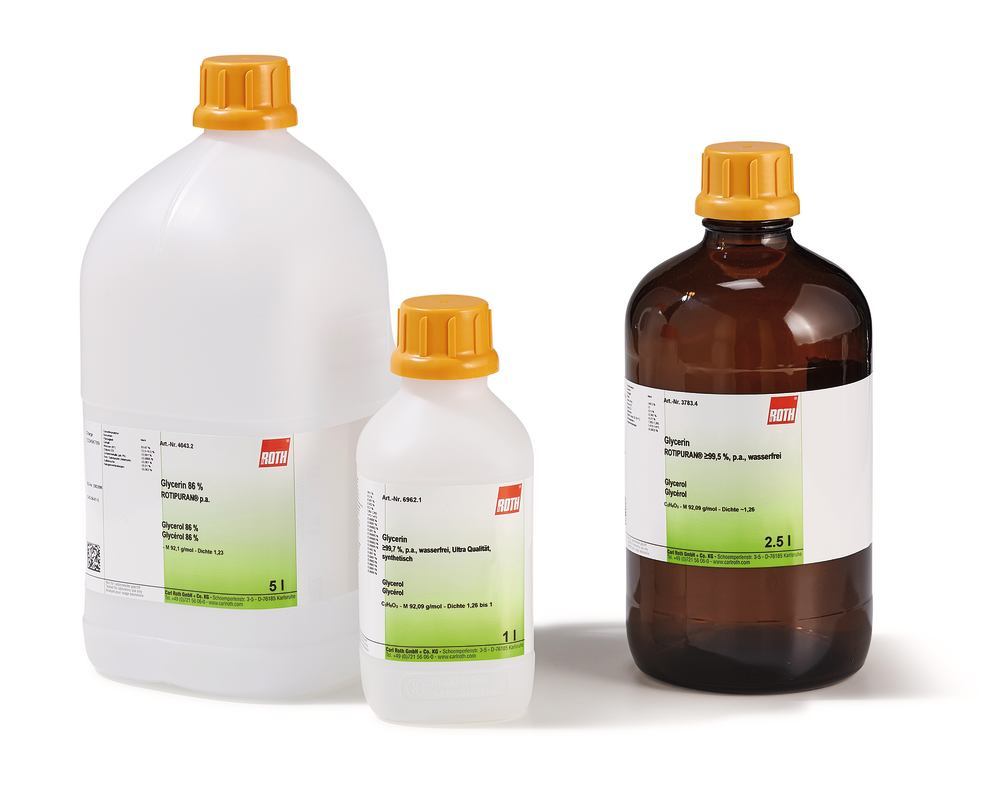
A Formulation Ingredient Defined by More Than Concentration
Formulation teams need ingredients that perform consistently from receipt through production. Glycerine 86 % (Vegetable), N. Ph. Eur, Non-Gmo combines plant-based origin with a defined concentration for pharmaceutical, cosmetic, food, nutraceutical and laboratory workflows. Beyond its humectant, carrier and solvent functions, its contribution can be calculated and controlled. Suitability must still be confirmed against the complete specification, intended application and relevant regulations.
What Does the 86 % Concentration Mean for a Formula?
An 86% grade is not interchangeable with concentrated glycerine on a one-for-one basis. It contributes both glycerine and a defined water fraction. Formulators must calculate the glycerine delivered and adjust separately added water when moving between grades. Ignoring this difference can alter viscosity, solids balance, drying behaviour or preservative performance.
A formula requiring a specific mass of glycerine should be calculated on an assay basis, not by replacing the same mass of a 99.5% grade. The calculation must reflect the specification and validated manufacturing instruction, keeping pilot and routine batches aligned.
Why Do Vegetable Origin, Ph. Eur and Non-GMO Status Matter?
Vegetable origin can support policies that exclude animal-derived feedstocks, while non-GMO status may matter for customer specifications or controlled supply chains. Both statements require appropriate documentation. Purchasing teams should confirm that declarations apply to the exact manufacturer, product and lot.
Ph. Eur positioning provides a recognised quality reference for controlled environments, but it does not qualify every finished formulation automatically. Manufacturers remain responsible for supplier approval, risk assessment, incoming testing and compliance with the relevant standard.
Which Quality Checks Support Incoming Approval?
Incoming control may include appearance, identity, assay, water content and selected physical properties. Density equipment can support controlled comparison when the test method, temperature and acceptance range are properly defined. Suitable Refractometers can also help laboratories assess refractive index or concentration as part of a validated quality-control procedure.
Neither test is a complete identity check. Results can shift with temperature, impurities and instrument condition. Laboratories should use calibrated equipment, representative samples and approved methods, then compare findings with the certificate of analysis and acceptance criteria.
How Does Temperature Influence Handling and Mixing?
Glycerine is viscous, and its flow changes with temperature. Cold material may transfer slowly and extend mixing time, while warmer conditions can improve flow. Uncontrolled heating may create variation or conflict with limits for other ingredients. Instructions should specify temperature, equilibration time and mixing sequence.
Where rheology is critical, Viscosimeters can help compare batches under repeatable conditions. Spindle, speed, sample temperature and measurement time should remain consistent because results from different methods may not be comparable.
How Can Accurate Dosing Reduce Batch Variation?
Viscous ingredients require a transfer method suited to the batch size and equipment. Small-scale development may use controlled weighing, while production systems may rely on pumps or closed transfer lines. Useful Weighing accessories, bottling and mixing supplies can support cleaner preparation and reduce material loss during laboratory work. Compatible Containers, bottles, tins and canisters also help preserve material condition during dispensing, sampling and short-term storage.
Mass-based dosing is often easier to control because density and temperature influence volume. The process should define tare checks, transfer tolerances and management of material retained in hoses or vessels, especially during scale-up.
What Documentation Should Follow Each Batch?
Traceability begins at goods receipt. Teams should record the supplier, manufacturer, lot number, quantity, receipt date, expiry or retest date, storage location and container status. Clear Marking solutions can help identify opened containers, internal batch codes and status labels while reducing the risk of mix-ups on shared production or laboratory sites.
The certificate of analysis, safety data sheet and origin declarations should be controlled. During a deviation, these records help investigators compare lots and assess whether the material contributed.
Which Pack Size Best Supports Efficient Procurement?
Current category options include 25 kg, 250 kg and 1000 kg formats, allowing buyers to align supply with pilot, medium-volume or bulk requirements. The lowest unit cost is not always the best operational choice. Annual consumption, storage capacity, dispensing equipment, shelf life, handling risk and leftover material should all influence the decision.
Smaller packs reduce open-container time and simplify development. Larger formats may improve efficiency for repeatable production when the site can receive, store and dispense them correctly. Forecasting should consider lead time without creating expiry risk.
What Should Buyers Confirm Before Ordering?
A practical purchasing review should cover the following points:
- Confirm the exact 86% concentration and relevant assay basis.
- Verify vegetable origin and required non-GMO documentation.
- Review Ph. Eur compliance against the intended application.
- Check the certificate of analysis and safety data sheet requirements.
- Select a pack size compatible with usage and handling equipment.
- Define storage, temperature and contamination controls.
- Establish incoming tests and traceability records before release.
Building Consistency from Raw Material to Finished Batch
Reliable use of vegetable glycerine connects specification, formulation calculation, testing and process control. Accounting for water contribution, temperature-dependent flow, dosing and documentation reduces variation. Controlled purchasing also ensures that origin claims, quality expectations and pack size match operational needs, turning a versatile raw material into a predictable input for auditable formulation work.